Tuesday, July 18, 2006

Judgement

We had an interesting bible study at NCYM-C. We discussed 3 parts of Deuteronomy and a section of 1 Corinthians 11. Bob Gosney, who led the bible study, said that he had intentionally chosen very difficult passages. The passages from Deuteronomy had to do with reciting Israel's history as something of a ritual, and the latter part of 1 Corinthians talks about communion. Bob jokingly said we were dealing with "3 Rituals and a Sacrament". I had a rather odd way of looking at a section of 1 Corinthians 11 and I wanted to share. Here is the passage (1 Corinthians 11:27-32):

For this reason, whoever eats the bread or drinks the cup of the Lord in an unworthy manner will be guilty of the body and blood of the Lord. A person should examine himself first, and in this way let him eat the bread and drink of the cup. For the one who eats and drinks without careful regard for the body eats and drinks judgment against himself. That is why many of you are weak and sick, and quite a few are dead. But if we examined ourselves, we would not be judged. But when we are judged by the Lord, we are disciplined so that we may not be condemned with the world. (NET Bible)

This is probably one of those passages that Quakers hurry past, especially with the blood drinking and all, but I think deep down, there is some relation to our practice. I think the key to looking at this section is in the word "judgment". Most of the time, we hear "judgment" used as one of those "end times" things where all the bad people go to Hell and all. But in this case, "judgment" is used in the present tense, as is the word translated as "are disciplined".

Now, although liberal Quakers don't talk about it much, there is a judging aspect of the inner Light that illuminates some of the dark sections of our soul. It can be a painful process, and I think this is really what Paul is talking about. It isn't that if you do this wrong you are going to Hell, but that if you do it wrong, the Holy Spirit is going to let you know about it. Sometimes we may speak in meeting and afterwards have a squirmy, uneasy feeling that we strayed from our guide. I think this is an aspect of that judgment and it isn't meant as punishment but a correction. It seems that Paul is exhorting us to pay attention and follow the inner promptings of the Spirit - not necessarily in following a ritual, but in everything that we do. And if we act against those promptings, God will let us know.

Worshipping Among Conservative Friends

Ceal and I visited the 309th Annual Gathering of the North Carolina Yearly Meeting of the Religious Society of Friends Conservative last week, and it was a wonderful, liberating experience. So many of my conversations with Friends revolved around either our personal spiritual lives, or the spiritual lives of our meetings. I found the Meetings for Worship to be very enriching and refreshingly devoid of political messages, and the Meetings for Worship with attention to business were also enriching. As one would hope with any gathering of Friends, it was a beautiful group of loving, welcoming, and nurturing people who made me feel at home immediately.

The thing I found liberating is that we all were speaking roughly the same language, so we could all speak openly about our experience in a deep way, instead of trying to translate it into vague, generic terms. We were able to sidestep all the discussion about tribalism, and "how do you define Quakerism" and discuss our life in the Spirit. After reading some of the comments about the gathering of Convergent Friends, I suspect many people had a similar experience there. LizOpp said this about the Convergent Friends gathering:

Convergent Friends seem to hone one other. We connect with one another around our common hunger and desire to delve more deeply into Quakerism, and the commonality is what carries us into the life of the Spirit, into the Stream. We move beyond words, beyond judgment...

The part about "hone one [an]other" really resonated with me, because I felt that so strongly at NCYM-C. That's really a key function of the community. That's why there are advices and queries, and why the NC conservative meetings labor to answer one of the queries as a community at every business meeting, and then read those answers at the yearly meeting. It is part of the process of honing.

I'm not saying that I think that liberal Friends need to become conservative Friends, but it does point out to me something that I think liberal Friends need to at least acknowledge: The more diverse people are in their spiritual experiences, the more difficult it is to convey them to other people in a deep, meaningful way.

I think the reason you see people coming to a Convergent Friends gathering and suddenly being excited and liberated while talking about Christ is because they have suddenly found a place where they can just let go and not worry about offending someone because they have different beliefs. If those conversations are anything like the ones I had at NCYM-C, they have absolutely nothing to do with excluding people or suggesting that other people's beliefs are somehow wrong. They have everything to do with trying to be a faithful servant to God.

It is much easier to just label these as tribal, or exclusive, or say that they really don't understand anything about Jesus, than it is to admit that they are excited because they have found something that had been missing from their spiritual life.

Monday, July 3, 2006

Acknowledging the Gifts of the Spirit

I participated in a Friendly Bible Study yesterday that discussed Matthew 9:14-26, which includes Jesus healing a woman with a hemorrhage and also raising a young girl from the dead. I had felt that one of the points of this section was that Jesus healed people. I was a little surprised that more than half of the group was uncomfortable with the idea of Jesus healing people, and less comfortable with the idea that any of us might be able to do the same. Some expressed difficulty with the idea that some people are healed and not others, and that it made God seem arbitrary or capricious. This was not really new to me, I have heard those comments before, but I think I was struck by the fact that the majority of this small group felt that way. Since then I have been reflecting on the possibility that the majority of (Liberal?) Quakers also feel this way.

It is interesting to apply this same line of thought to vocal ministry. Why does God speak through some people more than others, some never at all? Why can't God just speak directly to people? Doesn't that make God seem arbitrary or capricious as well? Why does God need or want our participation in getting her message out? If we can accept the idea that God may speak through us at times, why is it not possible that God may use us in other ways as well?

I specifically mention vocal ministry because I think that it is one (or maybe a combination of several) of the gifts of the Spirit mentioned by Paul in 1st Corinthians 12 (7-11):

To each person the manifestation of the Spirit is given for the benefit of all. For one person is given through the Spirit the message of wisdom, and another the message of knowledge according to the same Spirit, to another faith by the same Spirit, and to another gifts of healing by the one Spirit, to another performance of miracles, to another prophecy, and to another discernment of spirits, to another different kinds of tongues, and to another the interpretation of tongues. It is one and the same Spirit, distributing as he decides to each person, who produces all these things. (NET Bible)

So for Paul and the early Christians, healing wasn't just something Jesus did, some of them were also able to do it. They also recognized various other gifts amongst each other. I quoted this passage a few months ago when I was talking about speaking in tongues, and I was led to read it yesterday morning before Meeting for Worship. What stood out to me more yesterday was the passage that follows (12-26):

For just as the body is one and yet has many members, and all the members of the body – though many – are one body, so too is Christ. For in one Spirit we were all baptized into one body. Whether Jews or Greeks or slaves or free, we were all made to drink of the one Spirit. For in fact the body is not a single member, but many. If the foot says, “Since I am not a hand, I am not part of the body,” it does not lose its membership in the body because of that. And if the ear says, “Since I am not an eye, I am not part of the body,” it does not lose its membership in the body because of that. If the whole body were an eye, what part would do the hearing? If the whole were an ear, what part would exercise the sense of smell? But as a matter of fact, God has placed each of the members in the body just as he decided. If they were all the same member, where would the body be? So now there are many members, but one body. The eye cannot say to the hand, “I do not need you,” nor in turn can the head say to the foot, “I do not need you.” On the contrary, those members that seem to be weaker are essential, and those members we consider less honorable we clothe with greater honor, and our unpresentable members are clothed with dignity, but our presentable members do not need this. Instead, God has blended together the body, giving greater honor to the lesser member, so that there may be no division in the body, but the members may have mutual concern for one another. If one member suffers, everyone suffers with it. If a member is honored, all rejoice with it.

Not only is it important to recognize that there are different kinds of gifts beyond just vocal ministry, but that we don't all have the same gifts. I think that has fallen away somewhat within Liberal Quakerism from what I can see. It seems like we are hesitant to acknowledge a gift or try to nurture it because we feel like it creates an inequality. We don't really have recognized "elders" so much as people we privately consider "weighty Friends", and recorded ministers seem rare. I think the community and God would be better served if we were to acknowledge and nurture the various gifts within in the community. Recognizing that someone has a particular gift doesn't mean that other people aren't also given that gift from time to time, and it isn't necessarily permanent - someone may lose their gift. The recognition is more of the community taking responsibility for that gift - the individual for the exercise of the gift, and the others for the care and nurture of the individual. While the idea of having recorded ministers and elders seems like it sets up some kind of hierarchy, I think Paul's description of the Church as a body casts the idea of recognized gifts into a more egalitarian light. Not everyone can be the eye, and while the eye is important, it needs the protection of the eyelid. While the eyelid isn't a glamorous job, the eye may soon be unable to function without it - everyone is important, no matter what they do.

Sunday, June 18, 2006

A SAYMA Photo "Opp"

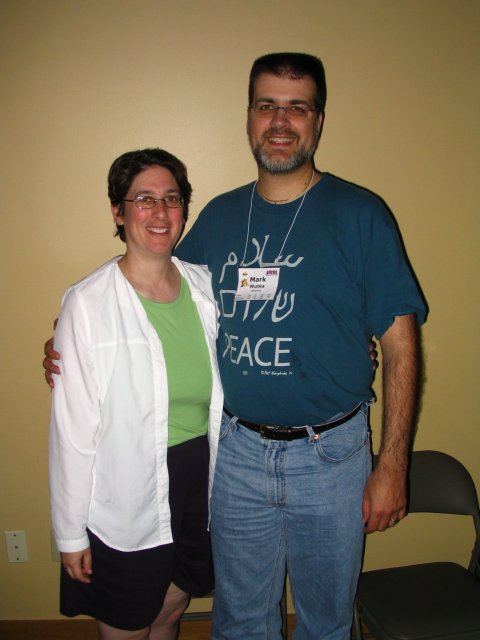
I'm happy to report a Liz sighting at SAYMA, and I have photographic proof:


I had a great time talking with Liz about FGC, blogging, and a number of other things. I wish we had had more time to chat.

I'm sorry I won't be at The Gathering this year, the On Fire! Renewing Quakerism through a Convergence of Friends interest group sounds really great Since it is hosted by a number of Friends from quakerquaker.org, I am curious to read the different viewpoints Friends from this group.

Wednesday, June 14, 2006

Healing Workshop

Ceal and I did our first workshop together this year at SAYMA. It was titled "Holding Each Other In The Light - Quakers and Healing". We only had about 2 hours, and we planned to do a Meeting for Worship for Healing in the second half, so we had to fly through some of the material. We touched on healing as a tradition among Quakers and back to early Christians and the Israelites. To me, the highlight of the workshop was the meeting for healing. It was similar to ones I have experienced at the Gathering - larger and more intense than what we usually have in Atlanta. It never ceases to amaze me how well Quakers take to this kind of meeting - there was vocal ministry, singing, touching, hugging, tears and smiles. We had 5 young Friends in the meeting as well, and several of them really seemed to take to it. I can't describe the joy I felt at seeing that.

During the workshop, I read this entry from George Fox's Journal from the period 1648-1653, because it really speaks to me:

When they had haled me to the common moss side, a multitude following, the constables, and other officers gave me some blows over my back with their willow rods, and thrust me among the rude multitude; who having furnished themselves with staves, hedge-stakes, and holm or holly bushes, fell upon me, and beat me on my head, arms, and shoulders, until they had deprived me of sense; so that I fell down upon the wet common. When I recovered again, I saw myself lying in a watery common, and the people standing about me, I lay still a little while, and the power of the Lord sprang through me, and the eternal refreshings revived me; so that I stood up again in the strengthening power of the eternal God and stretching out my arms among them, I said, with a loud voice, ' Strike again; here are my arms, my head, and my cheeks.' There was in the company a mason, a professor, but a rude fellow, who with his walking rule-staff gave me a blow with all his might just over the back of my hand, as it was stretched out; with which blow my hand was so bruised, and my arm so benumbed, that I could not draw it to me again; so that some of the people cried, 'He has spoiled his hand for ever having the use of it any more.' But I looked at it in the love of God, (for I was in the love of God to them all that had persecuted me), and after awhile the Lord's power sprang through me again, and through my hand and arm, so that in a moment I recovered strength in my hand and arm in the sight of them all.

It isn't just that this is an example of the gift of healing, it also speaks to why our connection to God is so important in living out Jesus' commandments. George Fox stood up and essentially turned the other cheek - to use the more literal interpretation of that action. He was able to do this because he was strengthened by God. I believe this is why we need to take care to nurture our spiritual life - it gives us the strength and support to carry out what God asks of us.

Tuesday, June 13, 2006

Meet Hector Black


The keynote speaker for the 2006 SAYMA Yearly Meeting was Hector Black, from the Cookeville, TN Monthly Meeting. He spoke on the subject of peace - we had speakers the previous night talk about simplicity, integrity, community and equality. While there are many interesting and inspiring aspects of Hector's life, the most riveting is how he and his family dealt with the murder of Hector's daughter Trish in 2000. His first reaction, amidst all the pain, was that he wanted to kill the man who killed his daughter. But as the love of God worked to heal his broken heart, he overcame that desire.

The Victim Impact Statement from the trial contains a lot of the material he used in that section of his talk. After giving a little background about Trish and how devastated they all were by the murder, this is how Hector concluded his statement:

I know that love does not seek revenge. We do not want a life for a life. Love seeks healing, peace and wholeness. Hatred can never overcome hatred. Only love can overcome hatred and violence. Love is that light. It is that candle that cannot be extinguished by all the darkness and hatred in the world.

Judge Goger, that is the reason we are not asking for the death penalty.

I know that ‘Forgive us our trespasses as we forgive those who trespass against us’ was not meant to be empty words. I don’t know if I have forgiven you, Ivan Christopher Simpson, for what you did. All I do know is that I don’t hate you, but I hate with all my soul what you did to Patricia..

My wish from my heart for all of us who were so terribly wounded by this murder, including you, Ivan Christopher Simpson, is that God would grant us peace.


For me, Hector's story had greater impact on me because he shared his initial reaction of "I'll kill the bastard!" Hector wasn't some perfect being who could just absorb an event like that and say "It's okay, I forgive you." He was a person who, through his anger and pain, allowed the love of God to work in his heart.

Monday, June 12, 2006

Back from Yearly Meeting

I got back from my yearly meeting (SAYMA) last night. I am still rather tired physically, but spiritually refreshed. This was Ceal's last year as registrar, which kept us both pretty busy, her much more than me. Having been enmeshed in several blog discussions, and lately worshipping with a more Christocentric group, I was a little curious as to what my reaction would be to the various goings-on at SAYMA. I worried that I might not have patience for things that I think are out of place, or are over-emphasized. As it happened, this was probably my favorite year at SAYMA so far. I have become acquainted with quite a few Friends, and I would estimate that during Meeting for Business, I could name more than half the Friends present. It was so wonderful to see everyone, to greet them, to worship with them and enjoy our time together. Although I am usually an introverted person, I took great delight in saying hello to so many people. Perhaps one day I will be like that all the time.

I feel like there are wisps of ideas running through my head, that I am trying to snag and bring forth here. In the next few days, I hope to be able to write more about SAYMA (and maybe provide a picture or two).